 Besorah
The manuscripts
The text as it was written
A flat line of words loses what the manuscripts carry. Besorah keeps those details — and explains each one when you tap it.
The details scholars and scribes notice
The text is typeset with the conventions of the manuscript tradition rather than flattened into plain lines.
Written and read: Ketiv & Qere
In about 1,250 places the manuscript writes one word and the tradition reads another. The written form stays in the line, exactly as the Leningrad Codex has it, and the read form follows in small gold type — [קרי: …] — or, in the Reader on a wide screen, stands in the margin beside its line, as in a printed Tanakh.
- Words read but not written, and written but not read, are marked too
- Tap the word: written and read side by side — and when they are different words, each one’s Strong’s entry, labelled as Strong’s
- Hidden with one switch in Settings, and never added to the English
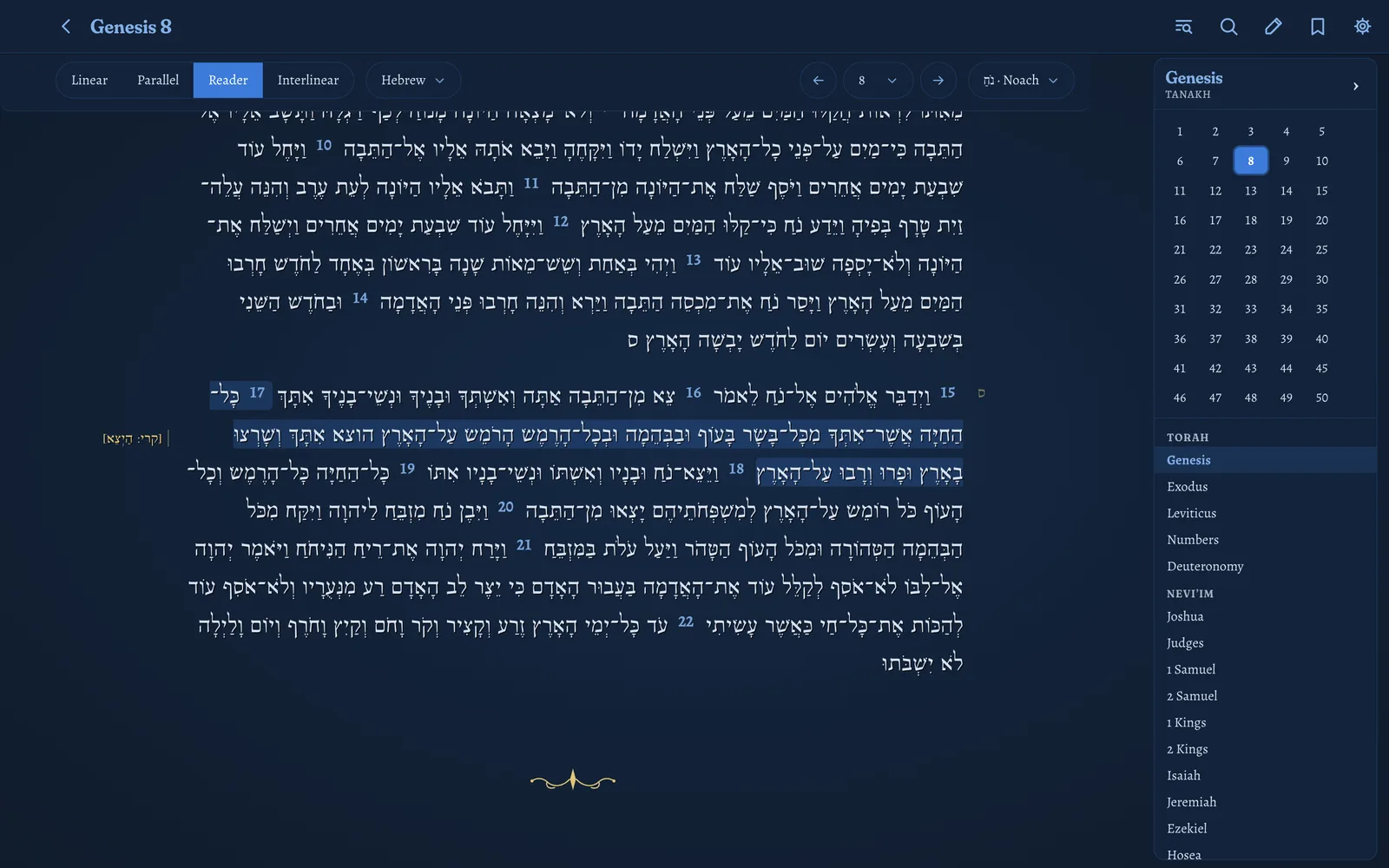
Drawn as the scribes wrote it
The oddities of the Masoretic text are kept, not flattened: the seven inverted nuns of Psalm 107 and the pair in Numbers 10, 27 enlarged and 23 diminished letters, the suspended letters (Manasseh, not Moses), and the dotted letters of the puncta extraordinaria — each at its exact letter, from the Masorah itself.
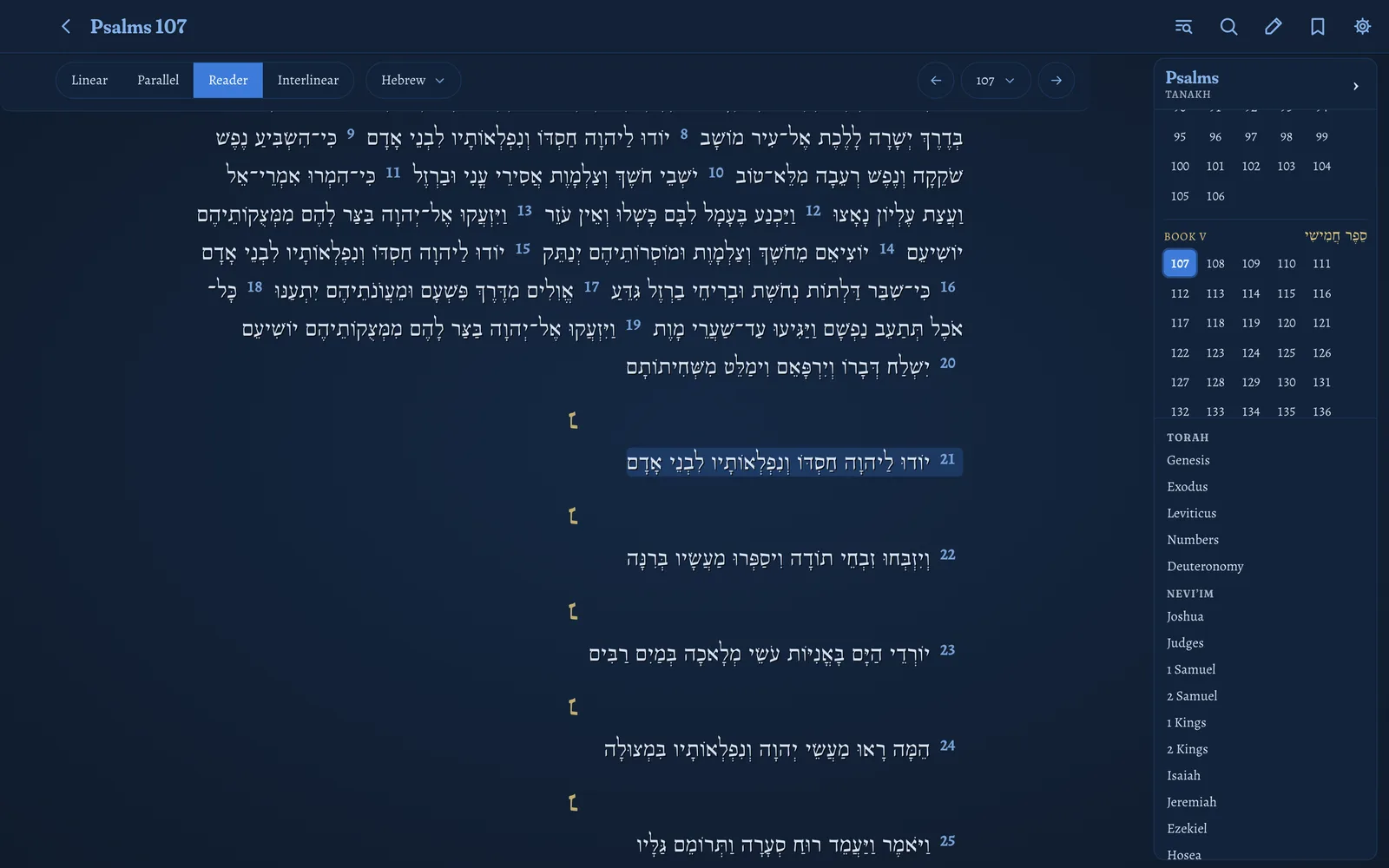
Poetry as poetry
The Song of the Sea, Haazinu, the Song of Deborah, David’s song — and the New Covenant canticles of Mary, Zechariah and Simeon — set in their scribal line-shape.
Songs in Scripture
Forty-two songs and prayers — from Lamech and the Song of the Sea to Hannah, Isaiah’s vineyard, Mary’s Magnificat and the hymns of Revelation — each set in its own line-shape, with a page that lists them all.
Acrostics marked
Psalm 119, 145, 34, Proverbs 31 and Lamentations show each stanza’s Hebrew letter in gold.
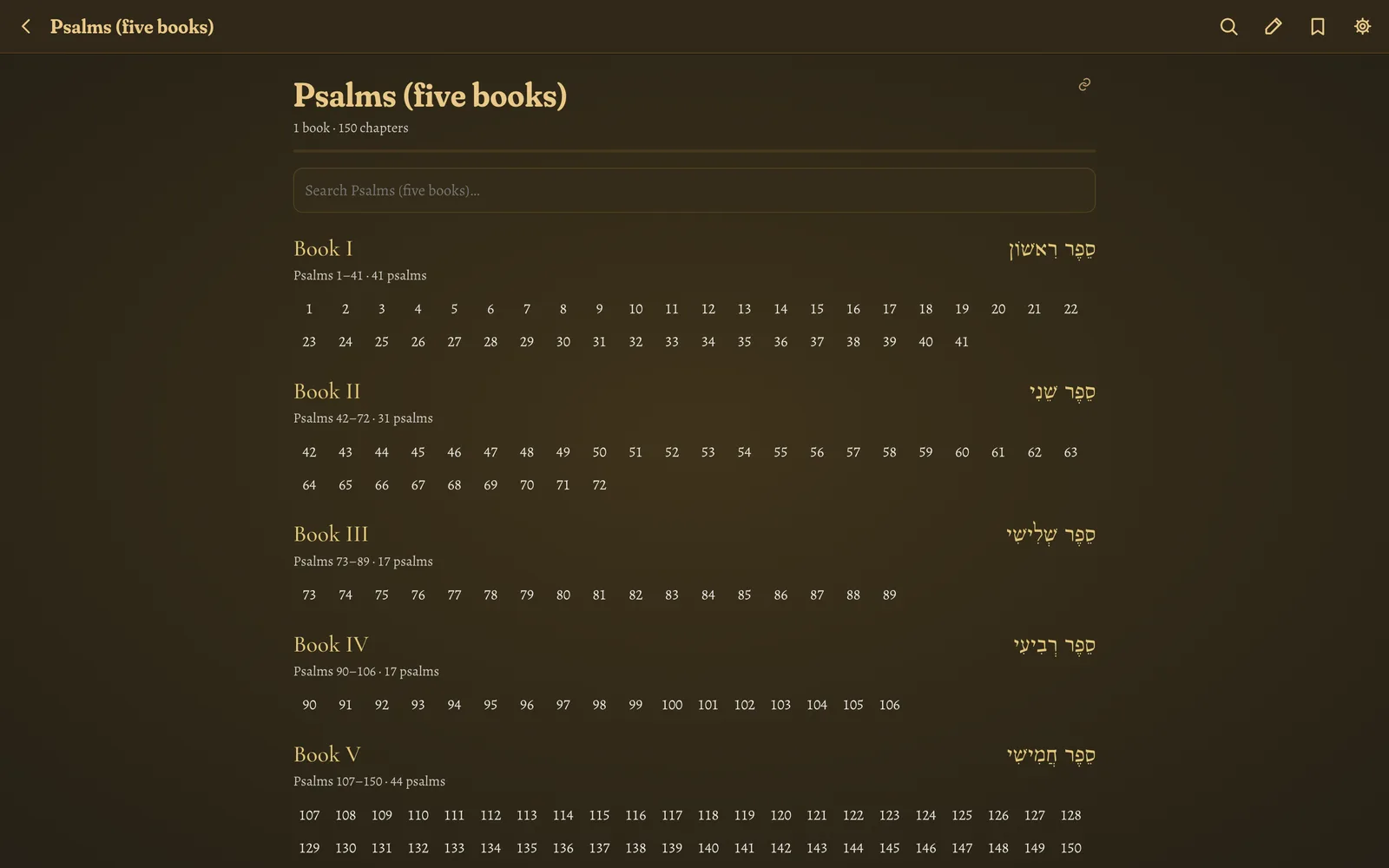
Psalms in five books
The Psalter’s five traditional books are marked in the chapter picker and have a page of their own — and each book closes with its own emblem, a colophon line, and its doxology set in gold.
The Name, reverently set
The four-letter Name is set apart in Hebrew, and you choose how it appears there — as written, without vowels, as Adonai, as HaShem, or abbreviated — in Settings. Only the display changes, never the text. Greek nomina sacra — θεός, κύριος, Ἰησοῦς, Χριστός — can be shown with an overline or contracted to ΘΣ / ΚΣ / ΙΣ / ΧΣ as the earliest copyists wrote them.
The Psalms, in their five books
The Psalter is one book, but the tradition divides it into five — each closing with a doxology. Book I to Book V head the chapter picker, and a page of their own lists every psalm under its book, with your progress. Each book then ends as a book should: its emblem, a closing line, and the doxology that seals it.
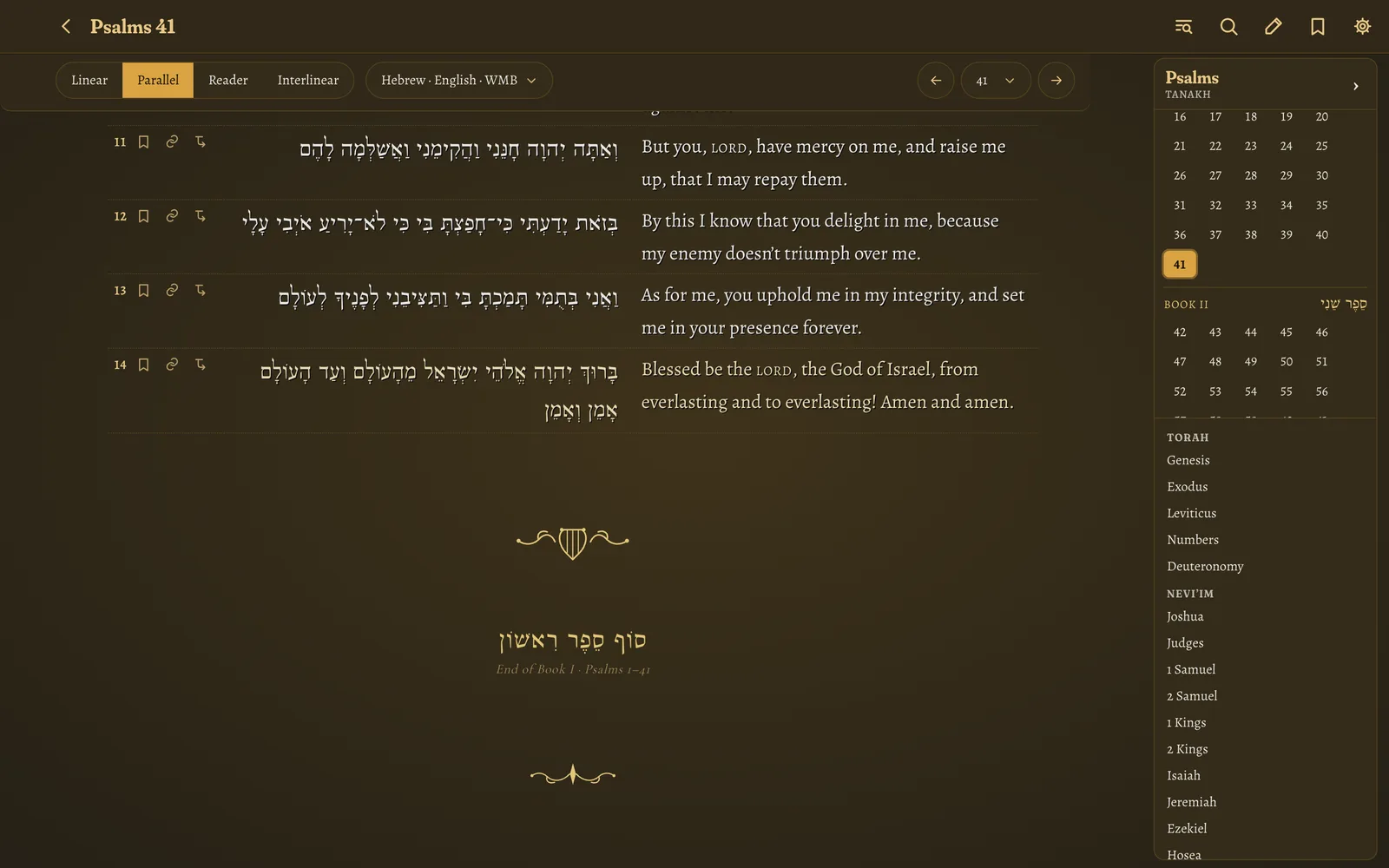
A heading for every book
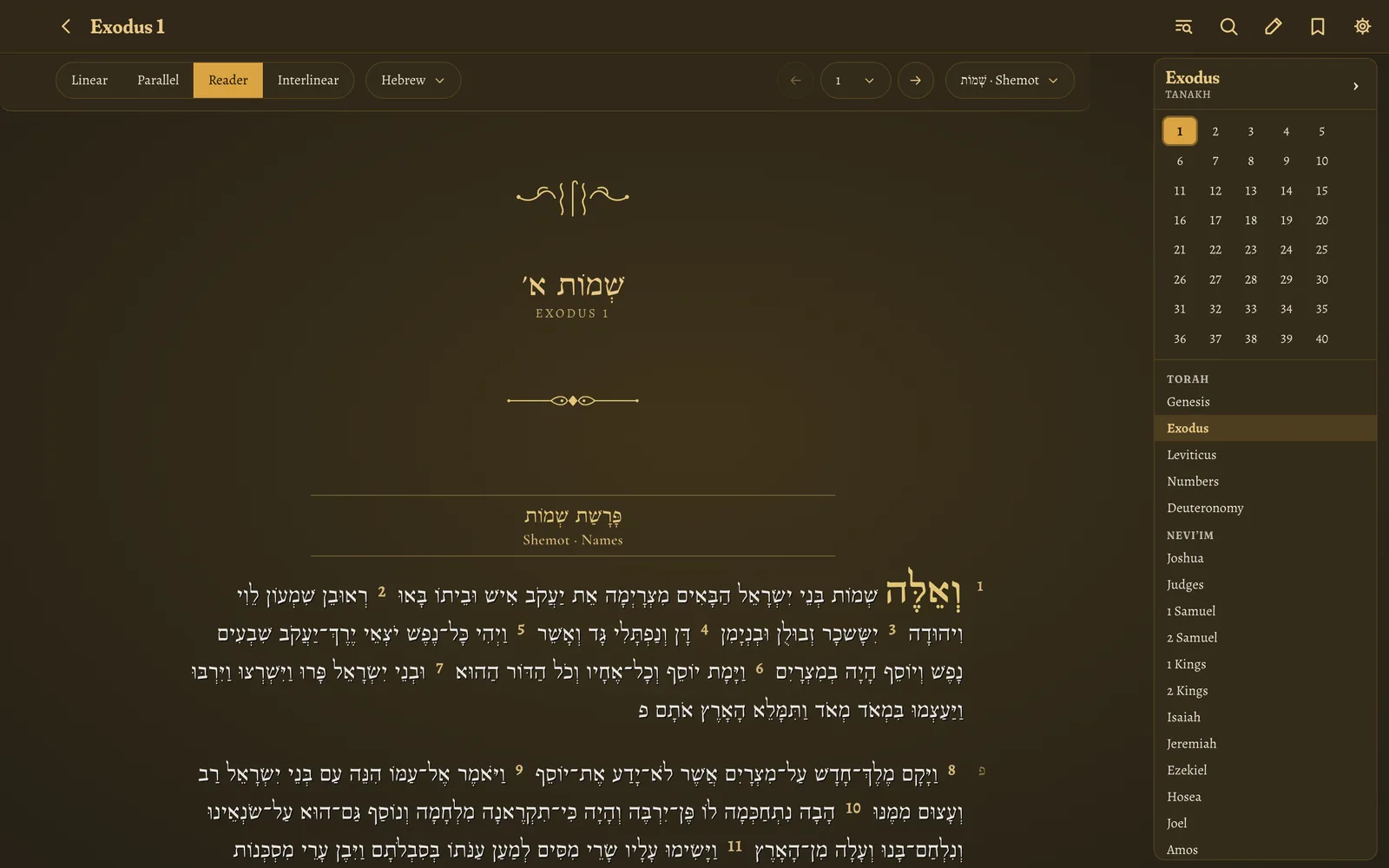
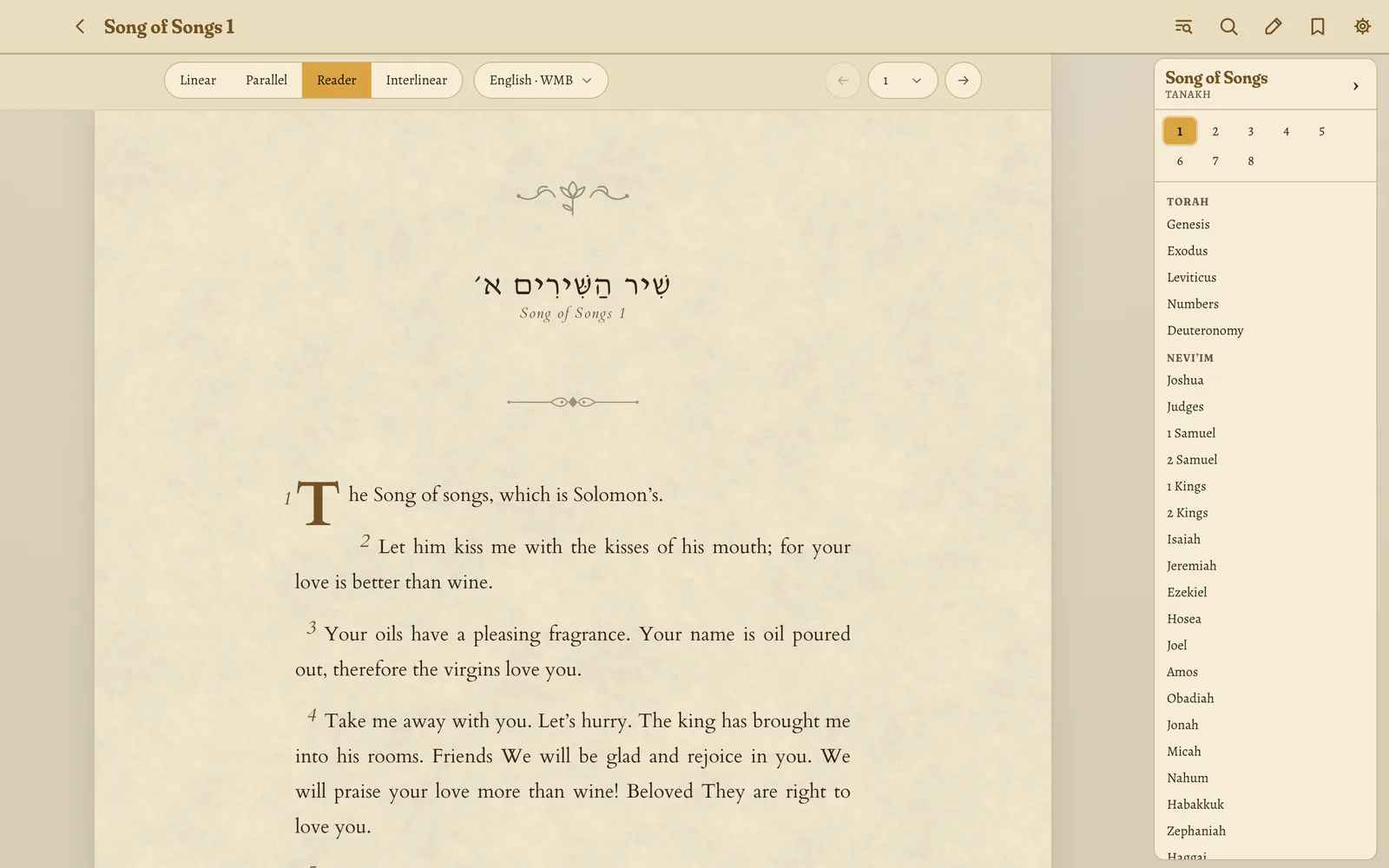
Each of the five books of the Torah, the five Megillot and the five books of the Psalms has its own emblem in the chapter heading — a tree and the first light for Genesis, parted waters for Exodus, a lily for the Song of Songs, a sheaf for Ruth — drawn in the same thin gold linework as the rest of the page.
See it in the text
Genesis 8:17 is a good place to start.

Nothing to download, install or sign up for.