 Besorah
Language tools
Study tools
Search across Hebrew, Greek and English. Every word explained. Every connection followed.
Search every verse, in every language
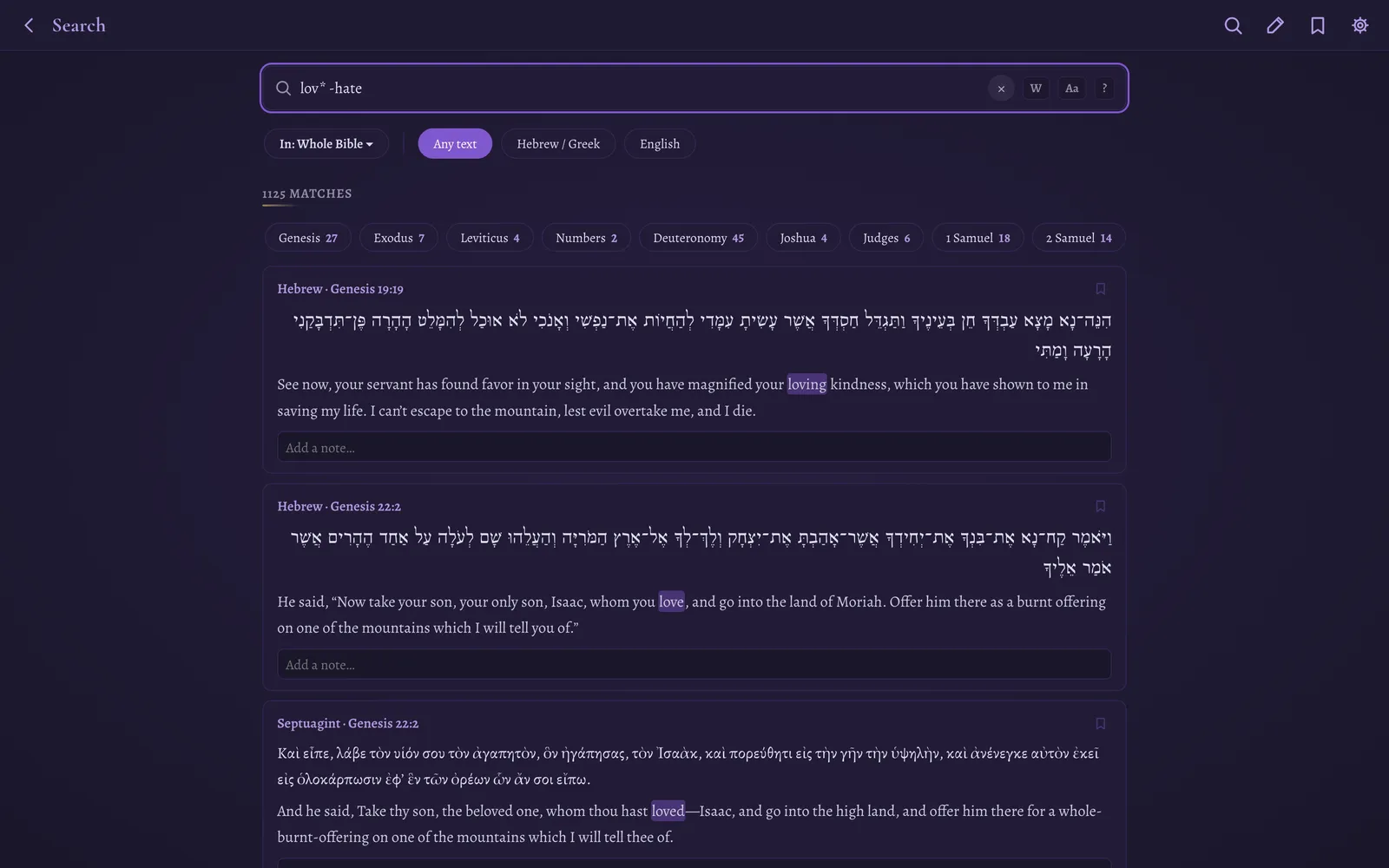
One search box finds matches across the Hebrew, Greek and English at once — and it knows that שָׁלוֹם and שלום are the same word.
- Vowel- and accent-insensitive: type plain letters, match pointed and accented text; final letters (ך ם ן ף ץ, ς) fold to their medial forms
- Real search grammar:
"exact phrase",lov*wildcards,+must-exclude, and full/regex/flagsthat match the pointed text, with Unicode-aware word boundaries - By Strong’s number:
strong:H430finds every verse using a word — across the Hebrew Bible, or both Greek editions forGnumbers - Scope it (“In:”): Torah, Prophets, Writings, Gospels, Pauline letters, the Targumim, Apocrypha — about twenty collections, or any single book
- Filter by text: Hebrew/Greek originals only, English only, or the Targumim only; restrict to the Tanakh or the New Testament; whole-word and case-sensitive toggles
- Filter the results: a “Show” row narrows hits to the Tanakh, New Testament, Apocrypha or Targum, and a per-book strip shows where the hits fall — tap a book to search only there
- Smart suggestions: type “love” and see the Hebrew and Greek words behind it; type “John 3:16”, “Ps 23” or “Onkelos Gen 1:1” and jump straight there
- Shareable: the query, scope and filters live in the address, so a search is a link — and recent searches and saved searches are kept for you
- Command palette (
⌘K): jump to any book, verse, word or setting from anywhere - Find in chapter with ⌘F / Ctrl+F, highlighting every match without disturbing your own highlights
- In the terminal too:
besorah search "in the beginning" --in torah --targum --whole --count
Strong’s, parsing and cross-references — built in
Tap a word, any word. No second app, no internet connection required.
Strong’s Concordance on every text
- Hebrew Bible — nearly every word (99.9%) tagged to its Strong’s number
- Greek New Testament — 97% of verses fully tagged
- Septuagint — Brenton’s Greek word-tagged (~80% of words), so you can study Old Testament Greek too
- Hebrew New Testament — tagged by matching each word to the tagged Hebrew Bible (~93%); approximate, and the card says so
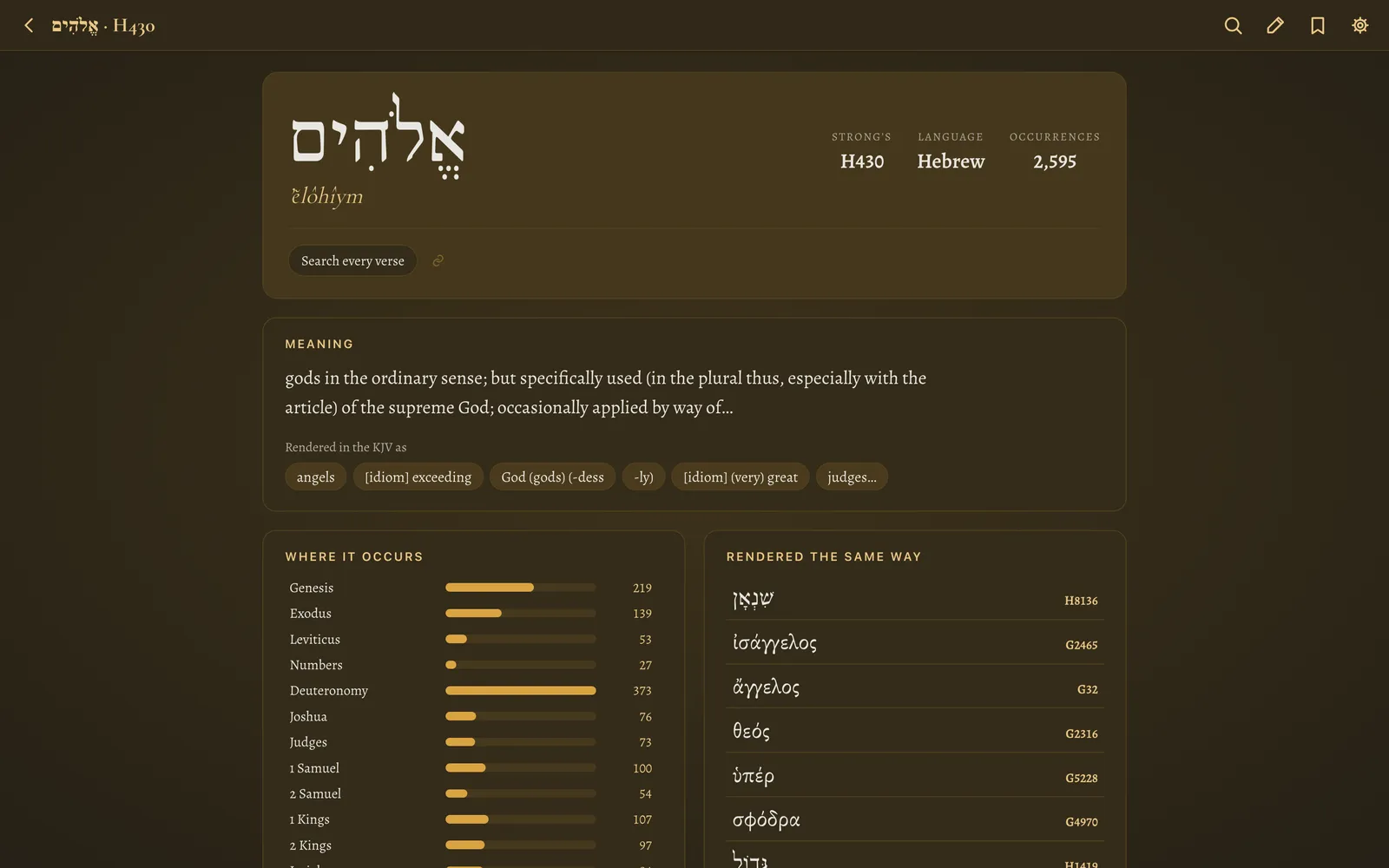
Every Strong’s number has its own page: lemma, transliteration, definition, KJV renderings, a per-book bar chart of where it occurs, words rendered the same way, and every verse that uses it. A word browser lets you search all 14,000 entries by number, transliteration or meaning.
Word card
Tap a word in the reader for its Strong’s number, lemma, common renderings, occurrence count and a one-tap “find every occurrence”.
Morphology
Parsing for Hebrew and Greek words: “Verb · Qal · Perfect · 3rd masc. sing.” — from the OSHB and MorphGNT data.
The Bible, connected
Genesis to Revelation on one line — not two testaments — with an arc for every cross-reference. Choose Isaiah, or Psalm 22, and watch where the whole Bible points back. Open the map →
Cross-references
A button on every verse opens related passages with their text, from OpenBible.info’s voted links — and each one leads to its own web of references.
Quotations, marked both ways
When one book quotes another — Matthew 4:4 and Deuteronomy 8:3, Hebrews and the Psalms, Chronicles and Samuel — both passages carry a small gold dot, and the verse’s card says who quotes whom.
Occurrence search
strong:H430 finds every verse that uses a word — across the Hebrew Bible, or across both Greek editions for G numbers.
A page for every verse
Open any verse — besorah.bible/verse/GEN.1.1 or besorah verse Gen 1:1 — to see every text of it side by side (Hebrew, Septuagint, Targum, English), the interlinear, each word and its cross-references together.
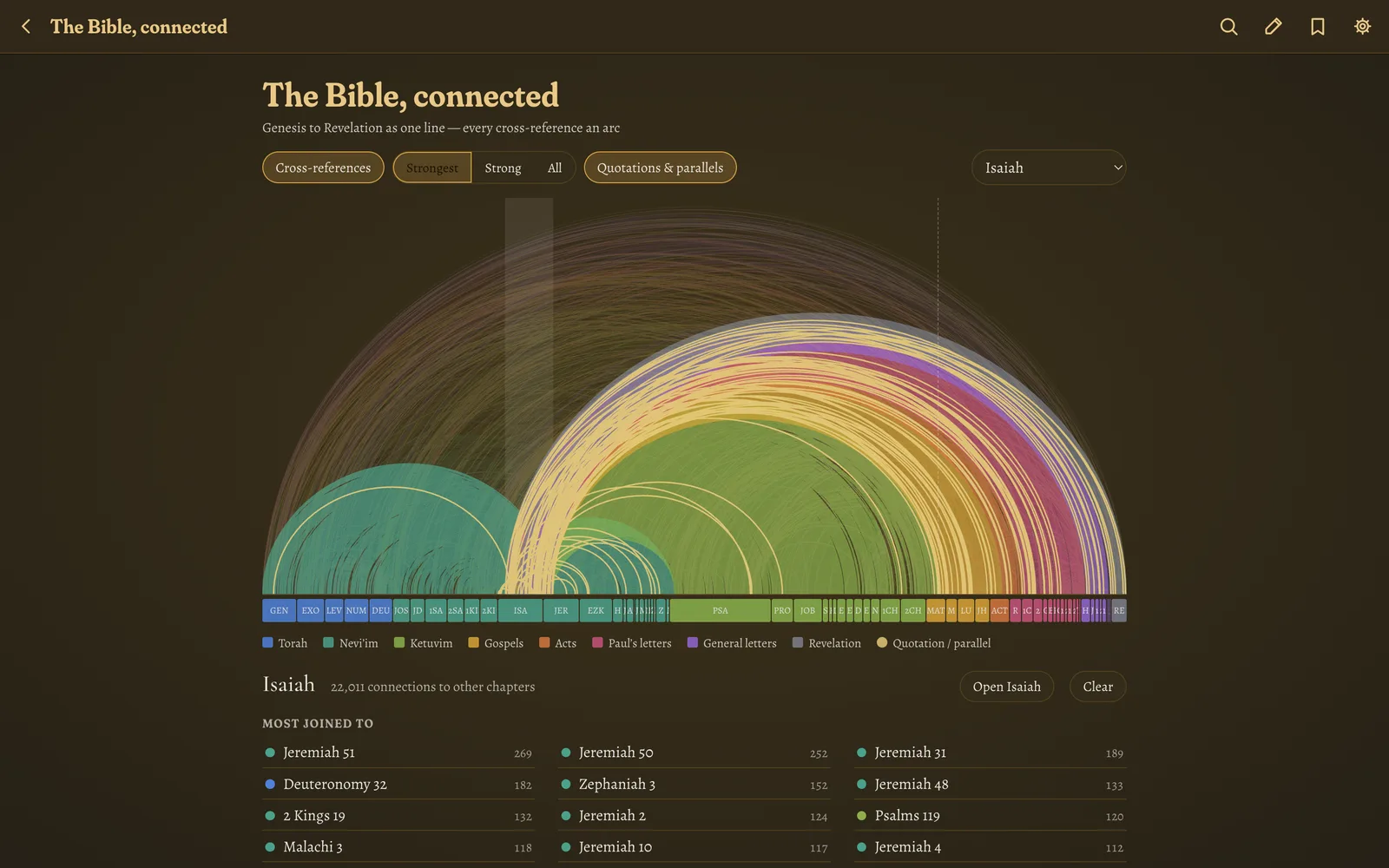
Isaiah, selected on the whole-Bible map. Each arc takes the colour of the book group that points back to it.
Look something up
Open a verse and tap any word.

Nothing to download, install or sign up for.